17014 S. Vermont Ave #C, Gardena, CA 90247
 (310) 856-3456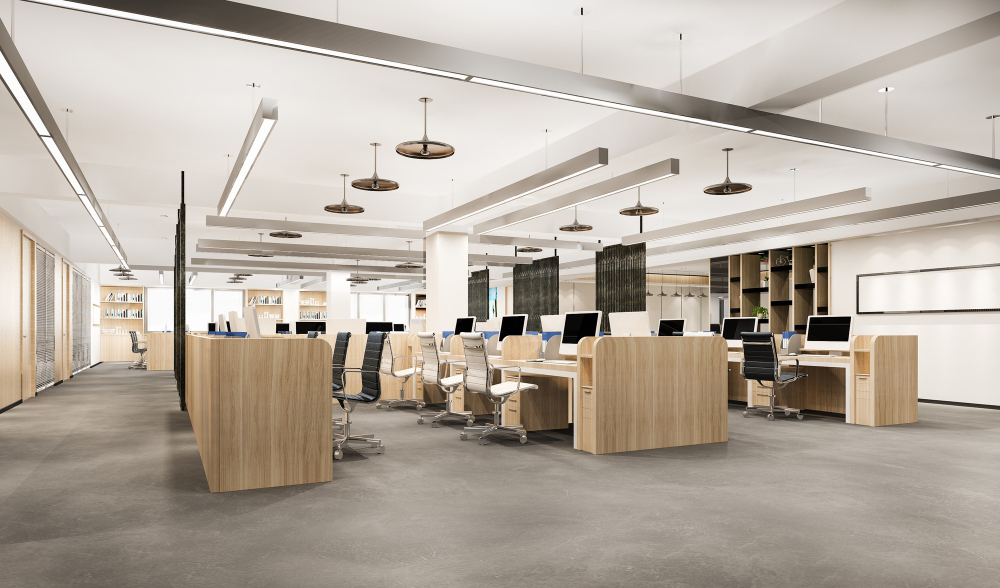
Types of Office Layouts
Choosing the right office layout isn’t just about placing desks or building walls; it’s about creating an environment that aligns with how your team actually works.
The layout defines more than physical space. It sets the tone for communication, focus, energy, and company culture.
In this comprehensive guide, we’ll explore the most effective types of office layouts used today, along with real-world examples, expert insights, and practical takeaways to help you determine which setup will best support your goals.
Whether you’re managing a growing startup, optimizing a small business floor plan, or building a hybrid work environment.
Understanding these core layout models is the first step in creating a more efficient office space layout.
Traditional Office Layouts: Order and Privacy at the Core
The traditional office layout is built on a clear structure, private offices, long corridors, assigned desks, and a layout that reflects organizational hierarchy.
It provides physical and psychological boundaries that support focus, confidentiality, and control. You’ll still find this model in industries such as law, government, and finance, where privacy is essential, and work tends to be more linear and document-heavy.
The downside, however, is the limited collaboration. Teams are segmented, departments are siloed, and spontaneous interaction becomes rare.
As an office design layout, this model communicates formality and authority. But without modern updates like shared collaboration zones or modular meeting areas, it can become rigid and outdated.
Open-Plan Offices: Designed for Visibility and Velocity
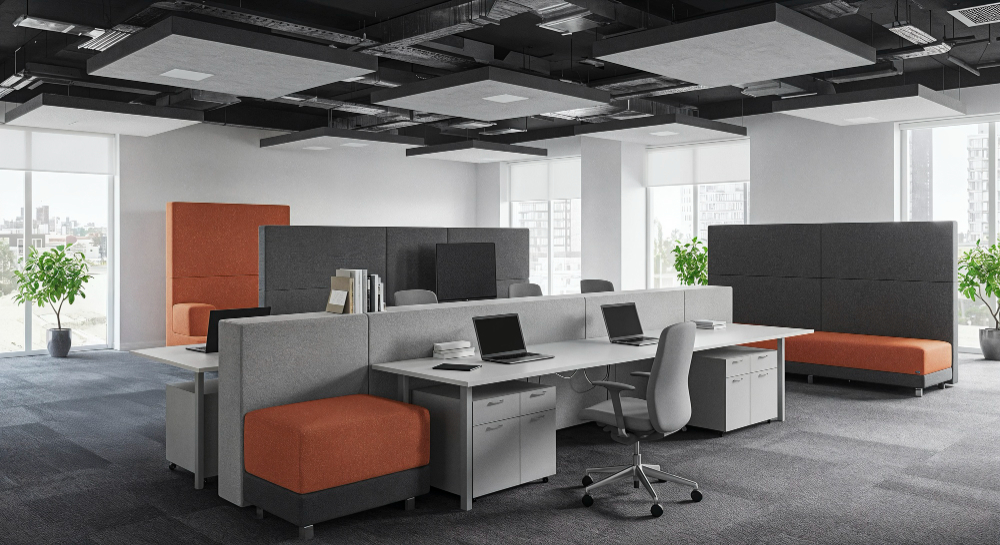
In an open-plan layout, barriers are removed, physically and culturally. Desks are arranged in large open zones with minimal dividers.
The setup encourages communication, collaboration, and visibility across teams. Many startups and creative agencies adopt this model to keep pace with agile workflows and fast decision-making.
But what fuels openness can also fuel distraction. Noise levels spike, and deep focus becomes a challenge.
Teams that thrive in open layouts typically implement noise controls, establish quiet zones, and utilize acoustic-friendly materials to minimize burnout.
If you’re looking for flexible office layout ideas that promote connection and teamwork, open-plan spaces can be an effective solution. Still, they must be supported by intentional design choices and established behavioral norms.
Cubicle Layouts: Controlled Focus Without Isolation
Cubicles offer something many office design layouts struggle with. With three-sided partitions and just enough separation, they provide privacy without total disconnection.
Employees can concentrate without feeling isolated, and space can be utilized efficiently. This layout is common in customer service, administrative departments, and tech teams, where structured workflow meets the need for focus.
While cubicles have historically earned a reputation for being dull or impersonal, modern cubicle systems are far more customizable, ergonomic, and visually appealing than the corporate grids of the past.
A well-designed cubicle layout can feel organized, efficient, and even energizing, especially when lighting, spacing, and personalization are considered from the start.
Private Offices: Space to Think, Lead, and Handle Confidential Work
Private offices remain a necessity in many environments. Executives, HR professionals, finance leaders, and legal teams often require dedicated space to manage sensitive conversations, focus intensely, and handle confidential information.
These layouts signal trust and autonomy. They also provide team leaders with a space to decompress and think strategically, something that’s increasingly rare in open offices.
The key to success is integration. Too many private offices on a floor can isolate leadership and weaken team dynamics.
But when used selectively and supported by shared areas and visible presence, private offices add value without removing leaders from the team environment.
Team-Based Layouts: Structuring Space Around Collaboration
Team-based layouts organize space according to workflow, not just department. Teams that frequently collaborate, such as marketing and sales or developers and designers, are often grouped in close proximity.
Desks are arranged in pods, whiteboards, shared screens, and project walls are often built into the surrounding space.
This layout is dynamic and productive. Information flows faster, feedback is instant, and group alignment becomes a matter of spatial design.
The challenge lies in balance. Without proper spacing or acoustic design, one team’s energetic sprint can distract another team’s quiet grind.
A high-performing team-based layout requires a thoughtful blend of openness and zoning, along with visual boundaries and flexible breakout areas.
When done right, it’s one of the most efficient office space layout solutions for modern, fast-paced teams.
Activity-Based Workspaces: Letting Function Guide Form
Activity-based layouts rethink everything about traditional seating. There are no assigned desks. Instead, the space is designed around tasks.
Quiet booths support deep focus, while open lounges spark collaboration. Enclosed rooms host meetings and private nooks offer solitude.
Employees move based on their needs. This model supports autonomy, trust, and a sense of flow.
It respects the reality that people switch between modes throughout the day: strategy, execution, reflection, and communication, and allows the environment to change with them.
Activity-based layouts work exceptionally well in hybrid environments, where in-office time is intentional and scheduled.
It supports employees who want to use their workspace more purposefully, rather than just showing up at a desk they barely use. Among all the office layout ideas emerging today, this is one of the most human-centered.
Co-Working Layouts: Community Meets Flexibility
Co-working spaces are built around movement, variety, and shared infrastructure. There are hot desks, private call booths, café tables, and common lounges. They’re designed to be fluid, not fixed, serving freelancers, remote teams, and growing companies.
These layouts invite interaction, reduce real estate overhead, and support a sense of community. They’re less about permanence and more about productivity-on-demand.
While they may not be ideal for high-security work or deep concentration, co-working layouts excel in environments where energy, networking, and flexibility are key priorities.
They also offer some of the most diverse and modern office layout examples for companies seeking inspiration beyond traditional models.
Hybrid Layouts: The Real-World Standard
Most offices today aren’t fully traditional, open, or activity-based; they’re hybrid. A little of everything, by design.
The hybrid layout reflects how we work now: some days at home, some days at the office, and different needs depending on the task.
In a hybrid setup, you’ll find private offices for focused roles, open pods for collaboration, quiet rooms for solo work, and bookable desks for drop-in employees.
The strength of this model is its flexibility; it adapts to different work modes without overcommitting to any single one. Creating a successful hybrid layout takes planning. It’s not just about mixing layouts.
It’s about defining when, where, and how space supports work and ensuring your infrastructure (technology, scheduling, culture) aligns with that purpose.
Home Office Layouts: Small Space, Big Impact
Remote work is no longer a perk; it’s part of the system, and the home office layout matters as much as any commercial design.
A poorly designed home setup leads to fatigue, back pain, distraction, and disengagement. An innovative layout leads to flow.
Good home offices prioritize ergonomic furniture, natural lighting, clear boundaries from shared living areas, and visual cues that signal “this is a workspace.”
Even in small apartments or shared homes, thoughtful layout choices, such as positioning a desk near a window or separating spaces with shelves or rugs, can enhance performance and mental well-being.
For many hybrid teams, supporting home office layouts is part of the new operational reality and often yields the most significant gains in employee satisfaction.
Half-Partitions and Team Clusters: Controlled Energy
Between open space and full walls lies the half-wall. These visual and acoustic barriers provide employees with a sense of focus without isolating them.
They’re especially effective in clustered teams, small pods of three to six people working closely but needing some control over their space.
Unlike isolated cubicles, clustered layouts encourage collaboration while still allowing each person to maintain their own work rhythm. These setups are often modular and can be adapted as teams grow or projects change.
They’re a smart solution for teams that move quickly but don’t want their workspace to get in the way of thinking.
Curved, Non-Linear, and Experiential Layouts
Not every office design follows a straight line. Some use curves, asymmetry, and flowing zones to shape behavior.
Rounded walls, oval tables, and circular lounge areas soften the work environment, creating a more organic feel.
These non-linear layouts aren’t just aesthetically pleasing; they can also influence creativity, ease tension, and signal a break from rigidity.
Used in executive areas, client-facing zones, or creative departments, they offer a tactile and emotional shift from standard office grids.
They’re not always the most space-efficient, but they do offer a distinct spatial identity, and for some companies, that identity is worth the tradeoff.
Choosing a Layout that Supports the Way You Work
There is no perfect layout, only one that supports your people, your workflow, and your future growth.
What works for a marketing agency may not work for a compliance team. What energizes a small team may overwhelm a large one.
The most efficient office space layout is one that’s intentionally matched to how your teams think, move, focus, and build. As you explore your options, don’t just look at trends; look at tension points.
Where are people struggling to focus? Where do ideas get stuck? Where does space go unused? That’s where layout has the power to shift your workplace from functional to high-performing.
If you’re reworking your layout or starting from scratch, you don’t need to spend more; you just need to spend smarter.
Looking for Smart, Budget-Friendly Layout Solutions? Cheaper Office Solutions helps businesses create high-performance workspaces without the high-end price tag.
From modular furniture to ergonomic setups and full office layout ideas tailored to your space, we help you make it work better, faster, and more affordably.
Get in touch if you’re ready to design a space that actually supports your people.